
Blog
Can We Use AI Tools to Write Grant Proposals?
Mira Pape · November 2, 2024 · 4 min read

Lately, we hear one question a lot: "Can we use AI tools to write grant proposals?" In this post, we look at the ground rules for using AI when you apply for funding and explain what you should keep in mind to avoid common pitfalls.
General notes on using AI for grant proposals
One thing up front: there is no uniform rule on using artificial intelligence (AI) to write grant proposals. So far, most funders don't explicitly regulate the use of AI in writing proposals. In most cases, you can use AI as long as you meet the formal requirements.
Do AI-assisted proposals have to be labeled?
As a rule, proposals created with AI tools don't need a special label. Still, it's important to read the funding guidelines to see whether there are any specific requirements.
One example: the German Research Foundation (DFG), a German public research funder, recently took a position and stated that using generative models to write proposals is assessed neither positively nor negatively. When writing peer reviews, however, reviewers may not use AI, in order to protect confidentiality. This shows that using AI can be perfectly acceptable, but it always has to meet the funder's requirements.
How do funders react to AI-written proposals?
At a funding fair where a range of foundations presented their work, I specifically asked how funders react to AI-written proposals. Interestingly, many small and local foundations had hardly come across AI-assisted proposals so far. That may be because smaller funders tend to receive traditional, non-digital applications, or because they simply don't notice. After all, if they are done well, these proposals should hardly stand out.
Larger foundations or public funders, on the other hand, may receive AI-assisted proposals more often, because their requirements and questions are more extensive and AI support saves a significant amount of time.
Are there legal restrictions?
The use of AI is increasingly regulated, especially under the EU AI Act, which sets requirements for the safe and ethical use of AI. Article 50(4) is particularly relevant:
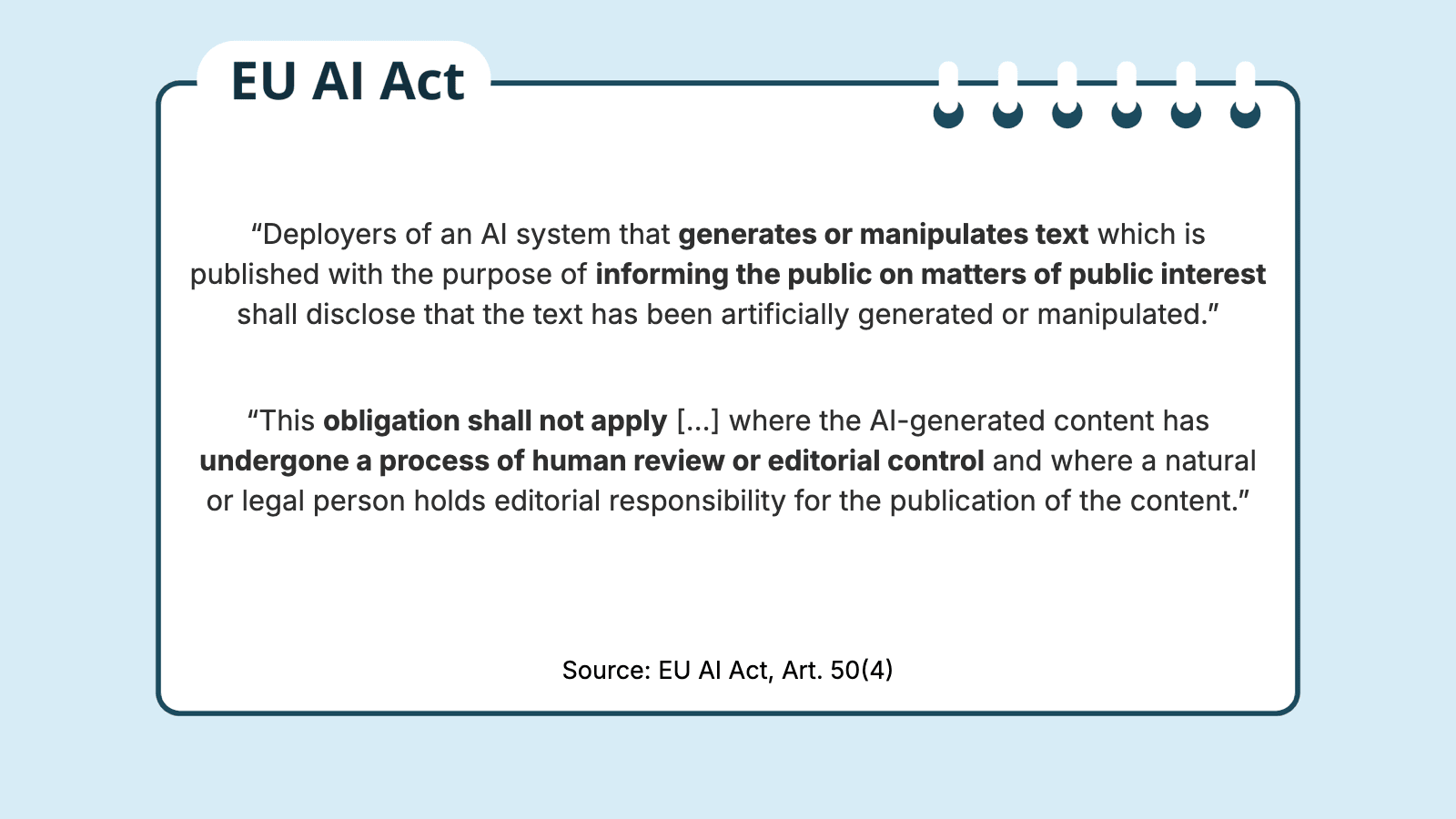
"Deployers of an AI system that generates or manipulates text which is published with the purpose of informing the public on matters of public interest shall disclose that the text has been artificially generated or manipulated."
"This obligation shall not apply […] where the AI-generated content has undergone a process of human review or editorial control and where a natural or legal person holds editorial responsibility for the publication of the content."
Using AI to write grant proposals is usually unproblematic, because a human reviews the proposal and a responsible person signs it at the end. The editorial responsibility that comes with the signature makes an explicit label for AI support unnecessary.
Do foundations use AI detectors to spot AI-written proposals?
There is a rumor that funders use AI detectors to identify proposals written with AI tools and possibly reject them. So far, though, this is no more than a rumor. Funders have to follow strict data protection rules, so they can't simply pass applicants' data on to third parties. However, if your proposal obviously reads as generated, for example because of generic language and awkward phrasing, it could be rated negatively.
The difference between AI-assisted and AI-generated text
Using AI tools well takes practice. Grant proposals aren't rejected just because they were written with AI. What does stand out negatively is vague language, a lack of coherence and a lack of understanding of the topic, which can result from proposals that are too heavily automated. If you use AI as a "crutch" and miss important details, you may hurt your proposal.
It isn't the AI tools themselves that are the problem, but the superficial presentation they can produce. Artificial intelligence can make writing a proposal easier when you use it deliberately. To get the most out of it, use AI only for support, not to write the whole proposal.
Conclusion: AI as support for grant proposals – a good choice?
Using AI can improve the quality of grant proposals and save time if you build it in carefully and deliberately. What matters is that the proposals come across as unobtrusive and professional. As with any tool, AI is no substitute for a solid understanding of the project and of the funder's requirements.