
Blog
The KIAD Approach – How AI Finally Becomes Practical for Grant Proposals
Mira Pape · January 27, 2025 · 8 min read
Writing grant proposals is part of everyday work for many nonprofits, and yet it's rarely anyone's favorite task. On the one hand, applying for funding comes with a lot of formalities. On the other, you constantly have to balance the funder's expectations, what your own organization can actually deliver, and the needs of the people you serve.
We specialize in writing grant proposals for nonprofits, and our work has shown us again and again: AI can be an enormous help here, provided you follow a clearly structured approach.
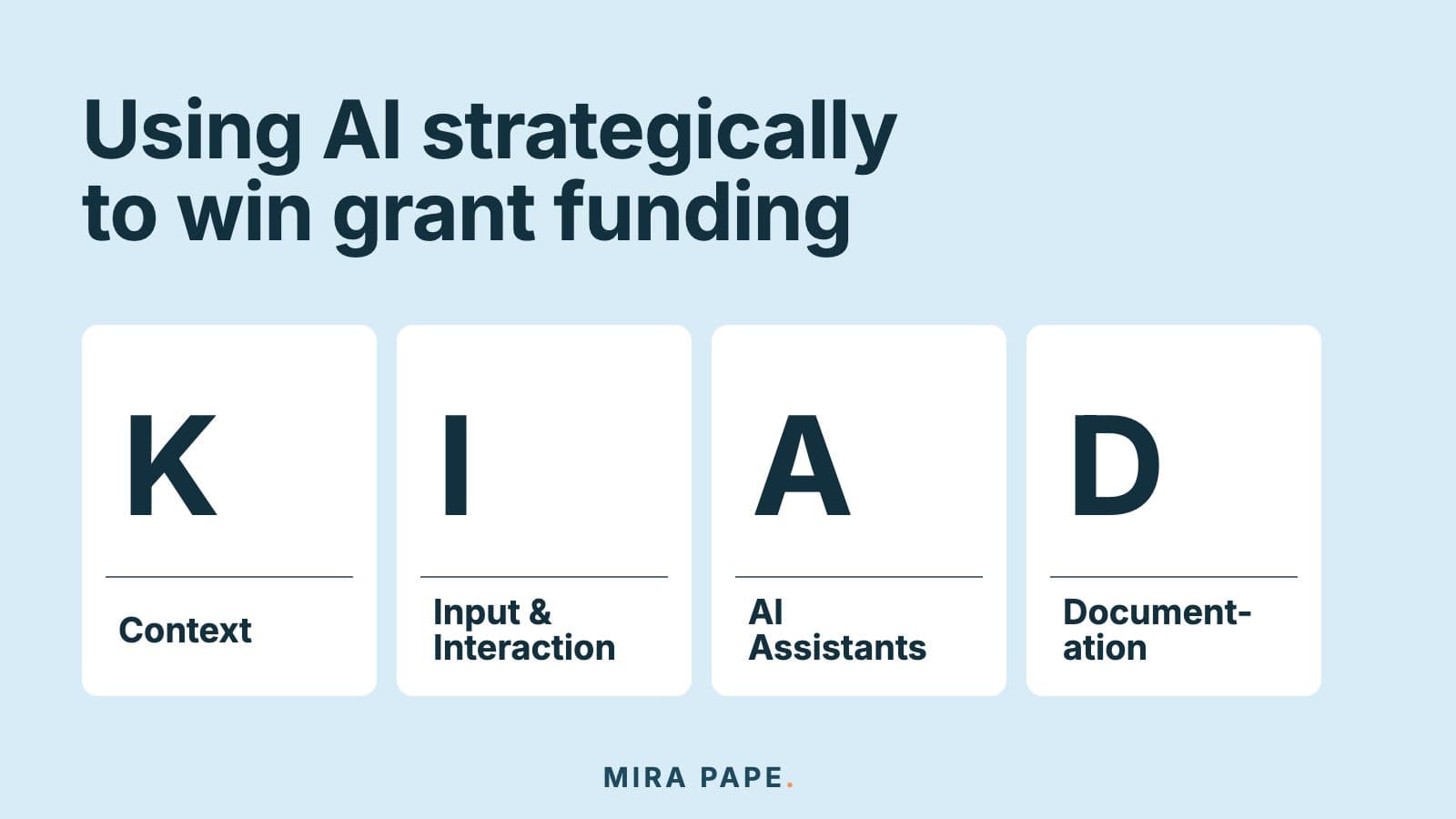
That's why we developed the K.I.A.D. approach. It shows how artificial intelligence (AI) can be used concretely and practically in the everyday work of nonprofits to make grant proposals more efficient, more precise and, ultimately, more successful. In this article, you'll learn what's behind it and how the approach benefits you.
Why grant proposals are so challenging for nonprofits
When nonprofits apply for funding, they often face the same hurdles:
- Complicated requirements: Many funding programs demand a clear structure, detailed project descriptions and exact budgets, all in language that has to be precise and convincing.
- Scarce resources: Time and staff are usually tight, and writing grant proposals competes with many other urgent tasks, from program work to bookkeeping.
- Uncertainty about approval: Every hour you put into a proposal is, at first, a bet on the future. If a proposal is rejected, you don't just miss out on the funding; the time you invested isn't paid for either. So how much effort is actually worth it?
- AI tools often stay too generic: In theory, AI tools could be a huge help, but the results are often too superficial, or they may even make up wrong information about your projects.
We developed the K.I.A.D. approach for exactly this reason: to help nonprofits use AI in a meaningful, practical way. It's not about letting a machine write texts blindly. It's about combining the strengths of AI with your team's hands-on knowledge.
What's behind the K.I.A.D. approach?
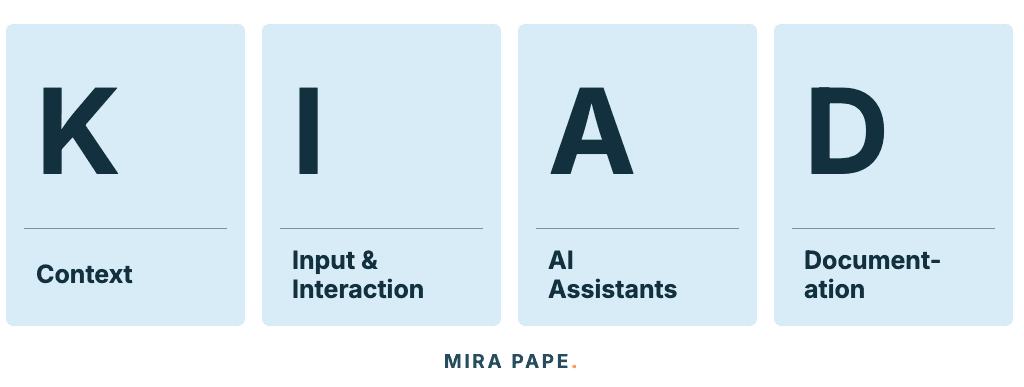
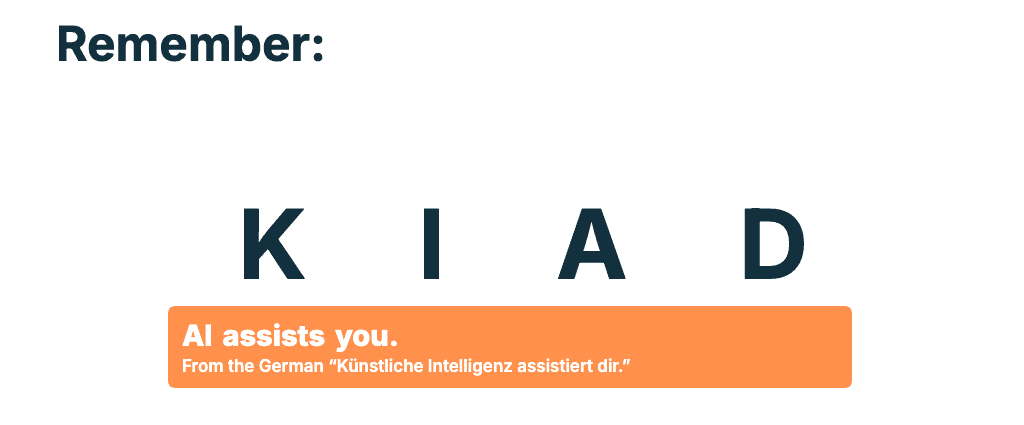
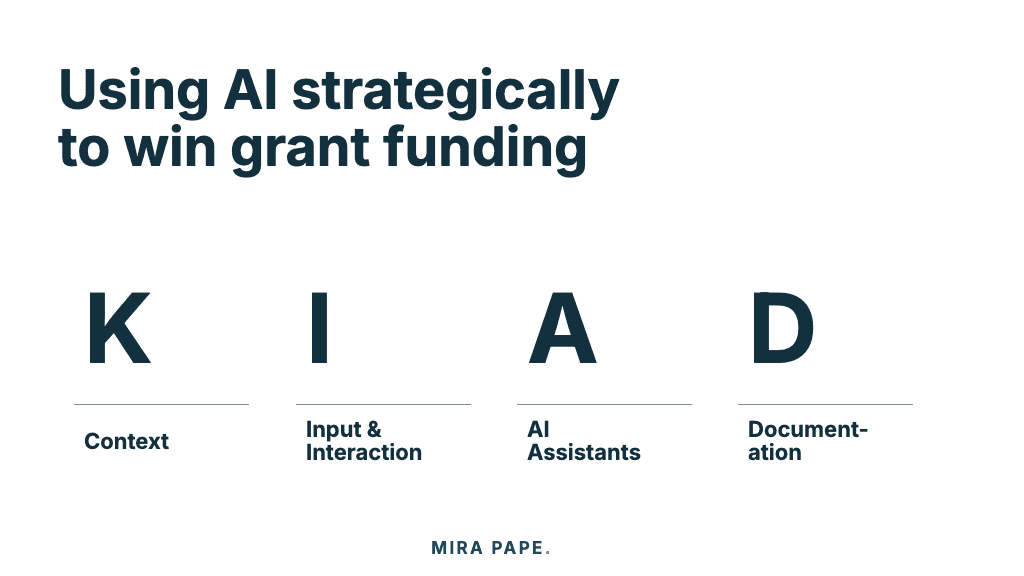
The K.I.A.D. approach is based on four steps (the letters come from the German words):
1. K = Kontext (context),
2. I = Input & interaction,
3. A = AI assistants (KI-Assistenten) and
4. D = Dokumentation (documentation).
We developed this concept over the course of our work with nonprofits, and above all from the many valuable insights we gained from the second round of our AI training program.
The training program "Using AI to win grant funding" runs for six weeks and gives nonprofits the chance to use AI specifically for writing proposals.
After the second round, with 26 participants in total, we held in-depth feedback conversations.
These conversations, and the consistently positive feedback, made it clear to us how important a clear roadmap is if AI is to become truly practical for nonprofits. The K.I.A.D. approach sums up these insights in four simple steps that you can put into practice right away.

The key to relevant results
The results of your AI tools are only as good as the information you provide. This is especially true for grant proposals, which often describe complex situations and require a high level of expertise. That's why it's essential to give the AI enough background knowledge (context).
In practice, this means:
- Use existing proposal texts and project outlines that describe your project.
- Collect studies, reports and background information that can serve as a foundation for the AI.
- The clearer and more structured your data is, the better the AI understands what it's supposed to deliver.
An example from practice:
One organization we worked with collected its successfully submitted grant proposals in an internal database. These texts gave the AI a foundation for recognizing phrasing that works well and typical structures. This made the results more relevant and better tailored right away.
By creating a solid information framework for the AI, you take the "guesswork" out of its job and improve the quality of its drafts. This ensures your proposals are practical, well-founded and tailored to the funding requirements, instead of being full of generic, interchangeable phrases.

Communicating with AI
A common problem when using AI is communication. Let's be honest: "talking" to a machine in natural language is still new to us.
With a simple search engine like Google, we often just type in keywords and usually get the results we were looking for. An AI application requires a different, more intensive approach. After all, when we talk to an AI, we expect much more specific results that are tailored to us.
An AI is more like a new colleague or an intern who doesn't know everything yet and needs clear instructions.
From search engine to conversation partner:
Instead of typing in single keywords or short questions, we should give the AI detailed and precise information. The more precise and structured our instructions, the better the result.
A prompt like "Write me a grant proposal for environmental protection" is rarely enough.
A better one would be:
"We are a nonprofit working in forest conservation in Krehwinkel County, and we want to write a grant proposal for the project 'Reforesting Krehwinkel Forest.' Our goals are: training volunteers, tree-planting events and raising public awareness. Please use formal, friendly language and keep in mind that we need to address sustainability and regional aspects. Attached is a document with our project concept."
Even though this first prompt will already get us a better result, we'll still need to improve it with specific follow-up questions.
In short: think of AI as an assistant in your writing process, one you're in a dialogue with. This perspective is key to getting high-quality results, from the first ideas through well-fitting phrasing all the way to the final grant proposal.

A team member who thinks along
AI can be much more than a simple tool. It can become a digital team member that actively supports you. In the K.I.A.D. approach, we develop custom AI assistants that adapt to the specifics of your organization.
What does that mean in practice?
- The assistant "knows" which funding programs are relevant to you.
- It knows your past projects and how they were described.
- It thinks along as you structure and phrase your proposals.
Example: A guidelines assistant for BMZ proposals
One participant in our AI training program regularly writes grant proposals for the German Federal Ministry for Economic Cooperation and Development (BMZ). To keep track of its extensive guidelines, she built a guidelines assistant and fed it all the relevant program lines and requirements. Now, while writing individual sections, she can pull up well-founded guidance on budget structure, funding criteria and formal requirements at any time.
Example: A feedback assistant for the final polish
Another participant focuses on the final check of proposals. Her feedback assistant reviews finished texts against the criteria of the respective funder, from language requirements to impact goals. This way, remaining gaps or unclear points are caught and fixed in time.

Learning and improving
No prompt is perfect from the start. That's why it's important to document the results of your AI use and learn from them. In the K.I.A.D. approach, this is the crucial final step.
Why documentation matters so much:
- You can trace which prompts and methods worked well.
- Your team develops a shared way of working that keeps getting better.
- Mistakes or weak spots can be identified and fixed. This makes your use of AI more efficient with every proposal.
Documentation doesn't just help you become more efficient. It also makes sure every team member benefits from the experience.
Why the K.I.A.D. approach is ideal for nonprofits
The K.I.A.D. approach was developed specifically for organizations that work with limited resources and still need to submit high-quality grant proposals. The benefits at a glance:
- Time savings: Clear processes and refined prompts significantly reduce the workload.
- Relevant results: Context and custom assistants make the texts more precise and more convincing.
- Sustainability: Thanks to documentation, the approach keeps evolving.
Practicality: The approach is tailored directly to the needs of nonprofits and is easy to put into practice.
Conclusion: Writing grant proposals with a system
The K.I.A.D. approach shows that AI in grant seeking can be more than just a trending topic. Integrated properly, it becomes a strategic tool that makes the entire proposal process more efficient and more targeted at the same time.
Instead of agonizing over the right wording or struggling to keep track of different funding guidelines, AI gives you more room for your actual core work: shaping and delivering your projects.
Now it's your turn:
- Want to see how the four steps fit together? Read more about our approach.
- Ready to start in practice? Our offers include beginner courses, digital products and free resources that each cover building blocks of the approach.