
Blog
Simply Too Long – Why AI Models Ignore Character Limits
Mira Pape · April 15, 2025 · 9 min read
Introduction
Character limits in grant proposals are non-negotiable. They ensure structure and make proposals comparable. But this is exactly where working with artificial intelligence (AI) often runs into trouble: AI tools frequently don't stick to character limits exactly.
For grant writers, who are bound by these requirements, this can mean a lot of extra work. This article looks at the reasons behind the problem and shows practical ways to still use AI efficiently.
Why do grant programs have character limits?
Grant funding comes with strict formal requirements. Among the most important are character limits for the individual sections and questions in a grant proposal.
There are many reasons for these limits:
- Ensuring comparability: Uniform lengths make proposals easier to evaluate and prevent scope and level of detail from varying wildly.
- Focusing on what matters: Program officers on the funder's side can only review a limited amount of information. Limits help because applicants have to focus on clear, understandable key messages and information.
- Meeting formal requirements: In many cases, character limits are binding. Exceeding them can lead to a proposal being rejected, or to the extra information being ignored, regardless of how good the content is.
That's exactly why mistakes with character limits have serious consequences in grant funding. In the worst case, a proposal that goes over the limit isn't reviewed at all, no matter how good it is. Especially with tight deadlines or highly standardized processes, there's often no time left for corrections.
Does AI really write too much?
It often feels as if AI models like to write more than you asked for. But is that really true, or just a subjective impression? Together with Sören Etler (data analyst), we took a closer look. In a detailed analysis, he shows that this is a systematic problem.
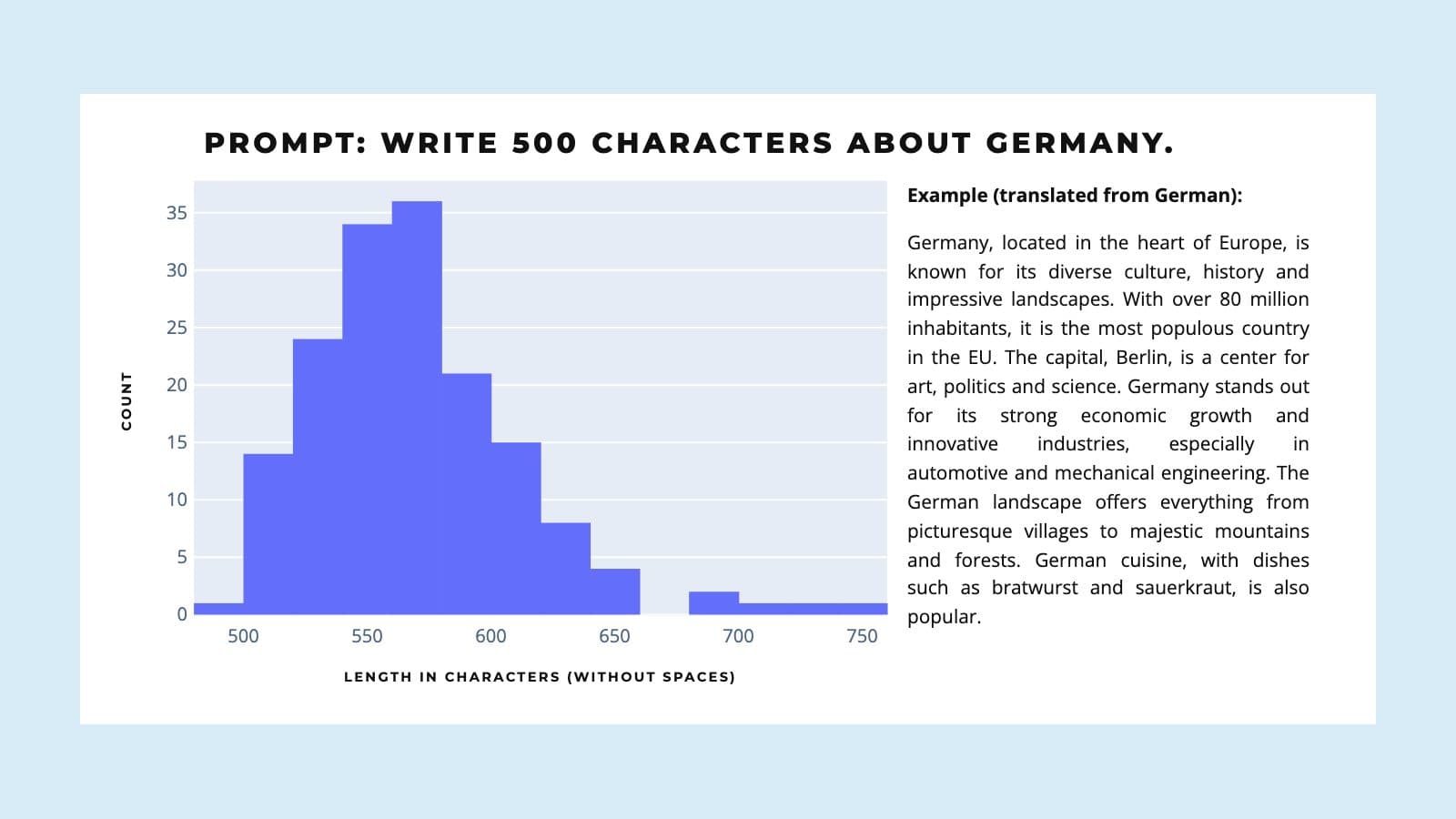
In an experiment, he analyzed how well AI systems handle character limits. As an example, he used the prompt "Write a text about Germany." (the tests were run in German). To set a character limit, Sören added the simple line "The text should be no longer than 500 characters." The result was clear:
Of 100 requests sent to the API, only one single response met the 500-character requirement exactly. All the other results were consistently longer, some at 555, 560 or even over 700 characters.
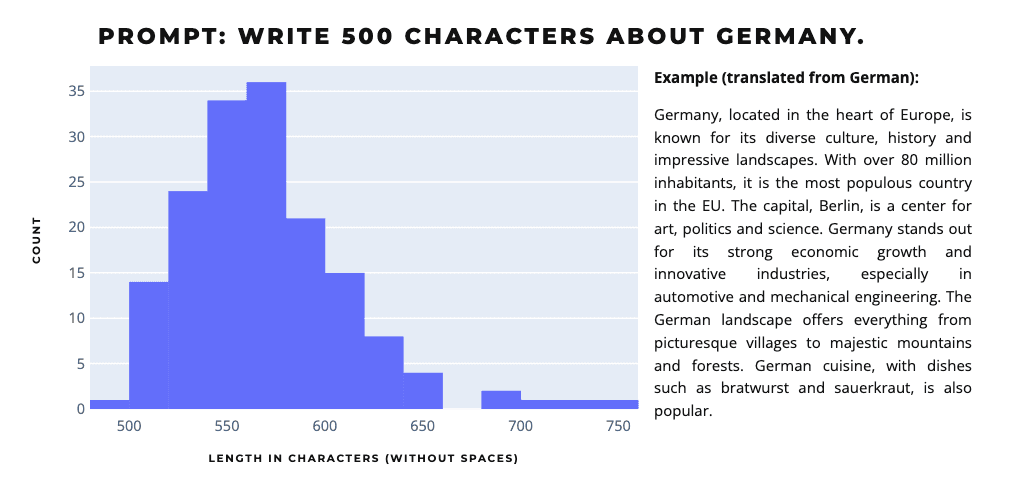
Figure: Many texts written by ChatGPT are too long, even when we specify a character limit.
ChatGPT currently uses OpenAI's 4o language model. Other language models, including those from other providers, may behave differently, but the basic tendency is always the same: the texts are too long!
The computer treats limits more like "recommendations" that are ignored in most cases.
Because these first results made us curious, we expanded the test.
Is there a difference between the free and the paid version of ChatGPT?
Our tests confirmed that most AI-generated texts don't stick exactly to the character limits they're given. At the same time, there are clear differences between the individual models, both in average length and in how precisely they meet the requirements.
Comparing GPT-4o and GPT-4o mini
Our test shows that GPT-4o mini writes almost 100 characters more on average than GPT-4o, even when both "try" to meet the same character limit.
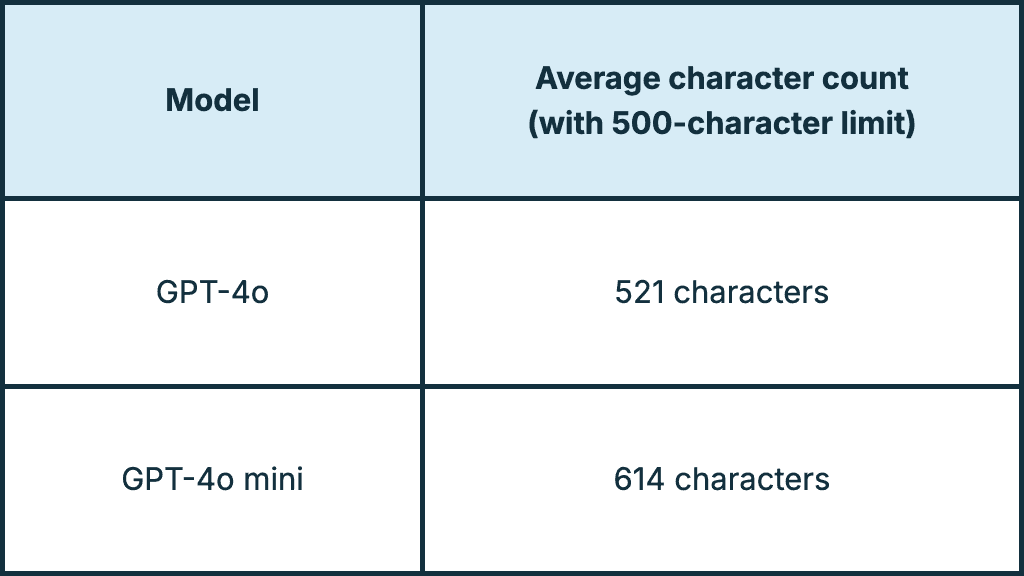
This means GPT-4o mini systematically exceeds the character limit by more than GPT-4o does. Its standard deviation is also higher, which points to greater variance in text length. In other words, when you run the same prompt several times, the text lengths vary a lot.
How do different prompting strategies affect whether the character limit is met?
Another interesting finding is that certain ways of phrasing the character limit work better than others:
• "The text should be no longer than 500 characters." and "The text may be at most 500 characters long." give the best results.
• "(max. 500 characters)" is acceptable, but less reliable.
• Adding "please" makes the text slightly longer on average.
• "Guilt-tripping" ("I'll lose my job if the text is longer than 500 characters.") doesn't work at all: the model ignores the limit almost completely.
Reasoning models are more precise
In the second round of testing, we also included the new reasoning models (o1 and o3-mini-high) in the analysis. These models handled character limits much better than GPT-4o and GPT-4o mini. For the most part, they stuck to the limit, and some were even very conservative, staying under 400 characters.
The reasoning models exceed the requirements less often and stay closer to the required character limit than GPT-4o or GPT-4o mini. That makes them especially interesting for use cases where precise character limits have to be met.
What happens without a character limit?
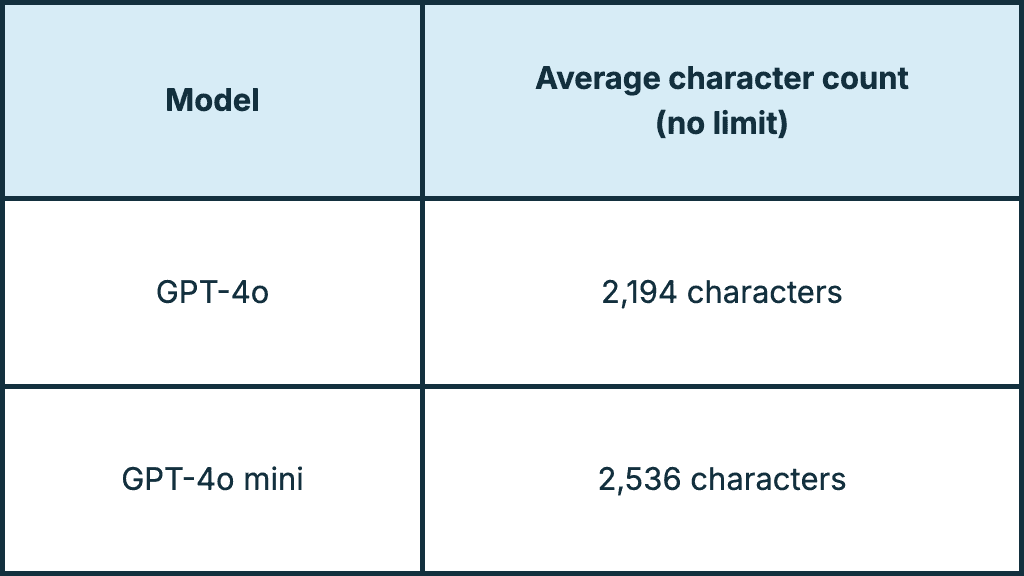
In another series of tests, we looked at how the models behave when no character limit is given. The result, not surprisingly, was that the texts got much longer and varied a lot.
At a glance:
- Without a character limit, GPT-4o produces texts that are four times longer on average, while GPT-4o mini gives answers five times as long as with a character limit.
- Weaker models are especially prone to generating longer, more rambling answers, often with more redundancy and unnecessary filler words.
- Remember: weaker language models ramble more.
Conclusion
If you need to meet character limits precisely, use reasoning models like o1 or o3-mini-high. They are the most reliable at limiting the number of characters.
Why AI ignores character limits
For all their progress, AI systems struggle with precise character counts. We can't say for certain why ChatGPT gives one answer and not another. It's very hard to look inside language models. That's why Sören offers a few possible explanations here:
1. Focus on content, not limits
AI models like GPT are designed to generate engaging, comprehensive texts. The focus is on the "quality" of the output, not its length. (Quality here means that the text sounds as good as possible, not necessarily that the information in it is factually correct.) Their training process was designed to optimize for this goal; character limits played a minor role at best. Constraints like character limits are a challenge because they restrict the AI's creative process. In the same way, ChatGPT would also find it hard to write texts that don't use the letter "e" or that use as many "double consonants" as possible, although language models have made enormous progress on this kind of task over the past year.
2. The complexity of counting characters
What seems trivial at first glance is technically demanding. The reason lies in how language models work. They are based on so-called tokens, the smallest units of text they process, which can be letters, syllables or words. But tokens don't correspond directly to characters or words. This built-in mismatch makes it hard for language models to control the length of a text precisely.
3. Weaknesses in shortening texts
On top of that, AI is designed to generate more detailed answers as a rule. This tendency to produce texts with more detail and greater length is based on the assumption that longer answers are perceived as more competent and helpful. Users can pick out the parts of the extra text that are most relevant to them. Long texts have something for everyone. With shorter texts, the system risks leaving things out in the wrong place. Maybe it's a bit like back in school: when you didn't know the answer to a question, you started to ramble.
Does it really matter that AI sticks to character limits?
Mira's take: Yes and no. Strict adherence isn't always necessary, especially in the early stages of developing a proposal.
When you write grant proposals with the help of AI, it often makes sense to treat character limits as a guideline at first.
Creating texts with AI is an iterative process:
- First draft: AI is used to give the context of a project a first shape.
- Analysis: Gaps in the text are identified, and targeted feedback is gathered on them.
- Refinement: Several drafts are generated, and the best-fitting passages are selected from them.
- Final polish: Individual phrases are improved, and the text is checked for spelling and grammar.
This approach saves up to 65–80% of the time, even if the AI doesn't deliver a perfectly worded proposal right away. Above all, it gives you a quick overview of which parts of the proposal are already clearly worded and where revisions are still needed.
It becomes critical in the revision phase, though:
When an existing text, for example from an earlier grant proposal, has to be adapted to the requirements of a new funder, it matters a lot whether the AI sticks to character limits. In these cases, precision is essential, because deviations in text length quickly lead to extra work and unnecessary rounds of corrections.
So our assessment is: character limits aren't always absolutely decisive, but in specific contexts, especially revisions, they become an important criterion.
Mira Pape

Mira Pape is a certified grant consultant with degrees in environmental and sustainability sciences. She gained professional experience at various sports and environmental organizations, where she worked in project management and grantmaking.
Over the past year, more than 2,000 people attended her introductory seminars on "Artificial intelligence in grant seeking." In her six-week AI training program, she has worked closely with 65 organizations on strategically introducing AI-supported processes into their grant seeking.
Sören Etler

Sören Etler is a data analyst who specializes in working with language and geodata. As an open data analyst, he helps organizations gain insights from their data and communicate them. This includes analyses, visualizations and talks on data and AI.
He studied business informatics and specialized in machine learning and natural language processing in his master's degree. He has worked in the innovation departments of IBM and SAP and volunteers with CorrelAid, a nonprofit network for data scientists.