
Blog
Writing Grant Proposals with ChatGPT?!
Mira Pape · August 31, 2023 · updated December 6, 2023 · 6 min read
This is the blog post accompanying our German-language podcast episode "Writing grant proposals with ChatGPT?!". In it, we discuss how we can use ChatGPT to improve our grant proposals. In this post, we give you practical ideas for using ChatGPT effectively, so you save time and make the process as pleasant as possible.
Can I have ChatGPT write my entire grant proposal?
Nope. At the moment, it (still) doesn't make sense to have ChatGPT write your proposals completely. What comes out is a big pile of generic words, strung together at random. Your chances of approval become vanishingly small if you let ChatGPT write your proposal.
It's also risky, because everything in the proposal has to be delivered later. So think of working with ChatGPT on your grant proposals more like working with a writing buddy: someone who supports you in specific places and can give you feedback.
Today we have 3 tips on how you can use ChatGPT to make writing grant proposals easier. As a powerful language model based on machine learning, ChatGPT can be valuable support for brainstorming, condensing text and improving writing projects.
Collecting ideas:
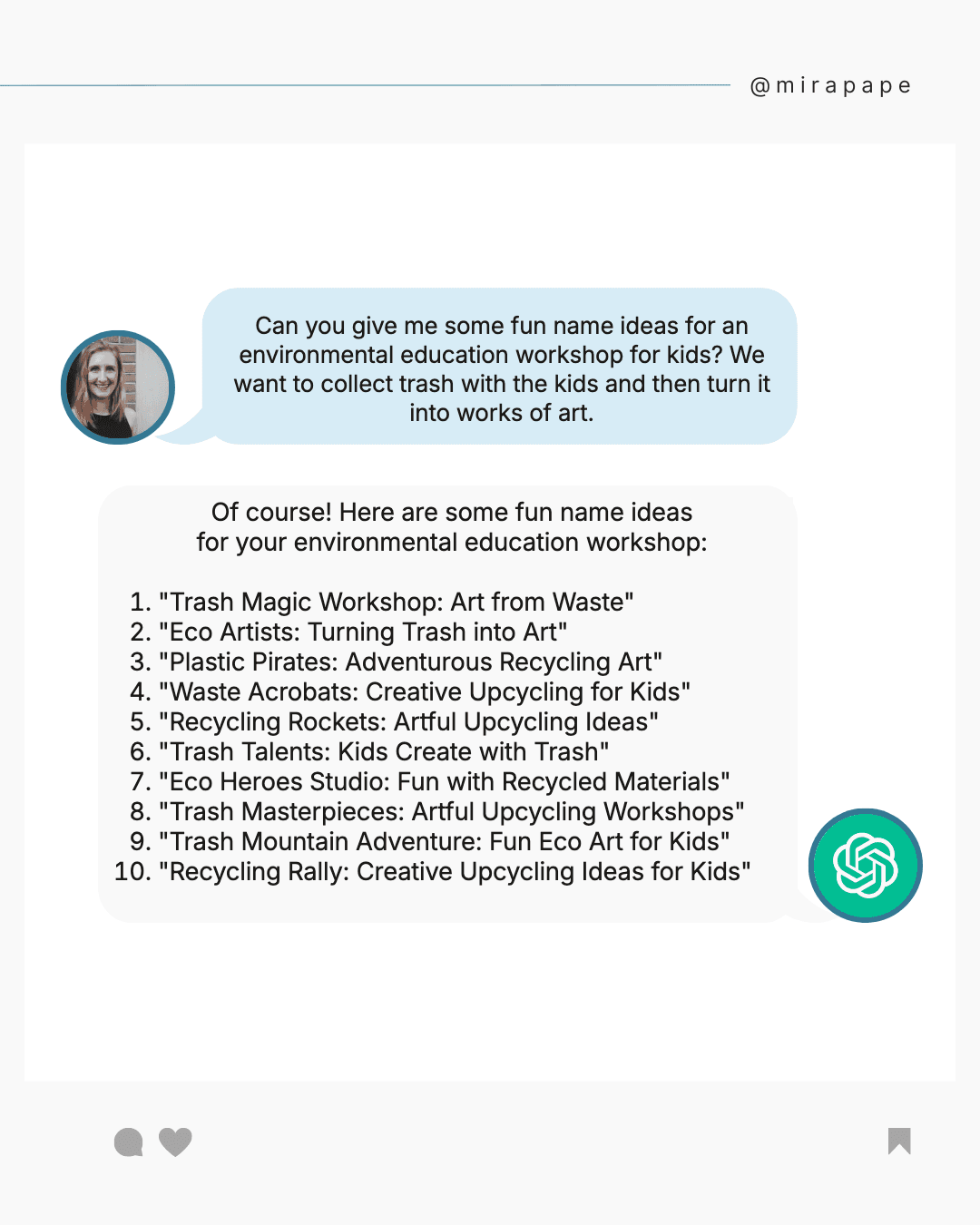
For creative writing tasks, like finding a good project title, ChatGPT can give you valuable ideas. For example, you can simply ask ChatGPT for advice and say, "Hey, we want to run an environmental education project, the target group is children and young people, this is how we've planned it, this is our target group. Do you have ideas for a name for this project? Please give us 20 suggestions." Maybe none of the suggestions will be one you really love, but the good thing is that you usually get ideas in lots of different directions. You can then build on these ideas and hopefully arrive at a project title that really suits you. So for collecting ideas, especially for creative tasks, ChatGPT is really useful, because it takes away the blank page: you don't start from zero, you already have a few ideas and thoughts to build on.
Even if the perfect title isn't there right away, you'll be inspired and can develop the ideas further to eventually find a fitting project title.
Shortening texts:
In grant proposals, you often have to paste existing texts into a new application form with a limited number of words or characters. Use ChatGPT to shorten the text with the prompt "Please condense this text to 350 characters." This gives you a shorter and hopefully more precise version of the original text. Keep in mind, though, that you should double-check the actual number of characters or words, because ChatGPT's accuracy in this area still has room for improvement.
Suggestions and improvements to texts:
ChatGPT can help you with suggestions, improvements and corrections to your texts. Simply ask for feedback and suggestions for improving your text. Or ask ChatGPT for alternatives to specific passages. This is especially helpful when you're working on your proposal at the last minute and there's no one around to proofread it at 10:00 p.m. ChatGPT then acts as a writing buddy and gives you valuable ideas for improving your proposal.
Research tasks:
Besides the uses above, ChatGPT is also suitable for research tasks. Sometimes we focus too much on our own project goals and neglect the value our project has for society. You can ask ChatGPT about social problems that arise when, for example, refugees aren't properly integrated into society. ChatGPT can give you a list of ten different social problems that help you strengthen your arguments for carrying out the project. For this, I like the tool perplexity.ai even better. It also tells you right away which sources the information comes from. For example, it gave me more recent figures on welfare benefits (Hartz IV, Germany's former basic income support) in a neighborhood of Lüneburg, which I hadn't found even after long searches on Google.
Using text formulas:
Another option is to use predefined text formulas. A text formula looks like this, for example:
We help [target group] [action] to [avoid a problem].
Once you've created templates like this with placeholders for different information, such as problems, statistics and target groups, ChatGPT can fill in the formula with the information you provide.
That could look like this:
Can you please fill in the following formula? We help [target group] [action] to [avoid a problem]. Our program is aimed at disadvantaged children, to help them manage their aggression.
ChatGPT:
"We help disadvantaged children manage their aggression to prevent violence and negative behavior."
If the result isn't quite what you had in mind, you can ask ChatGPT for ten more suggestions to adapt the formula. That way, you can combine different ideas from the suggestions and adapt the template to your needs.
Can you give me 10 more suggestions? Please also vary the adjectives instead of "disadvantaged."
ChatGPT:
- We help children in need manage their aggression to foster a harmonious social environment.
- We support at-risk children in managing their aggression to improve their mental health.
- We are committed to helping neglected children manage their aggression to improve their performance at school.
- Our goal is to help disadvantaged and underprivileged children manage their aggression to reduce the risk of interpersonal conflict.
- We work to help socially isolated children manage their aggression to foster their emotional stability.
- We support marginalized children in managing their aggression to improve their social integration.
- Our project aims to help vulnerable children manage their aggression to strengthen their self-confidence and self-esteem.
- We help neglected and abused children manage their aggression to prevent alcohol and drug abuse.
- We are committed to helping disadvantaged and homeless children manage their aggression to improve their family relationships.
- Our goal is to help children with special needs manage their aggression to improve how they resolve conflicts and to promote nonviolent communication.
Conclusion:
ChatGPT offers you many ways to improve your grant proposals. From collecting ideas and shortening texts to suggestions and improvements, ChatGPT can be your writing buddy. You can also use ChatGPT for research to broaden your perspective and bring social aspects into your proposal. On top of that, predefined text formulas can help you create proposals quickly and efficiently.
A lot will happen in the AI market in the coming years. There are already software solutions developed specifically for grant consultants and applicants. If you're interested, feel free to sign up for our newsletter, and you'll get a message in your inbox as soon as we've tested a new tool.